
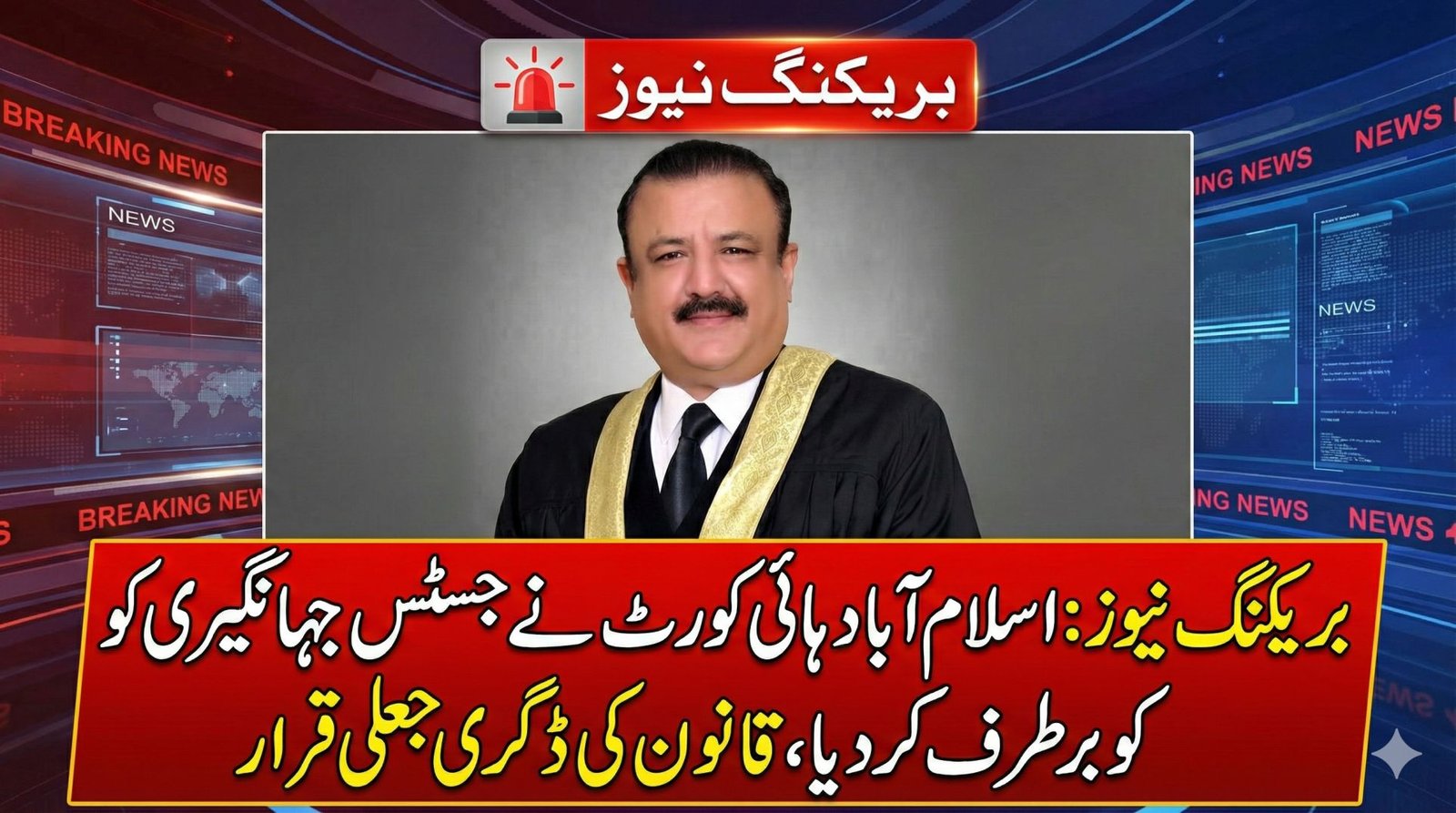
The Islamabad High Court has given a very important decision that has shocked Pakistan’s legal system. The court declared the appointment of Justice Tariq Mehmood Jahangiri as illegal and cancelled it with immediate effect. This decision came after serious questions were raised about his law degree. The case has attracted national attention because it involves a sitting High Court judge. Many people are discussing what this means for the judiciary, past court decisions, and public trust. This article explains the full story in simple words so that everyone can understand what happened, why it happened, and what may come next in this historic judicial case.
| Key Point | Details |
|---|---|
| Court | Islamabad High Court |
| Judge | Justice Tariq Mehmood Jahangiri |
| Issue | Invalid law degree |
| Result | Appointment declared void |
Justice Jahangiri Appointment Void: What the Court Decided
The Islamabad High Court ruled that the appointment of Justice Jahangiri was invalid from the first day. The court said he did not meet the legal requirements needed to become a High Court judge. According to the Constitution, a judge must have a valid law degree. The judges hearing the case agreed that this condition was not fulfilled. Because of this, the court ordered that he should no longer hold office. This kind of decision is very rare in Pakistan and shows that courts can also review the eligibility of judges when serious questions are raised.
Justice Jahangiri Appointment Void: Judges and Legal Process
The decision was announced by a division bench led by the Chief Justice of the Islamabad High Court along with another senior judge. The case was filed as a petition asking the court to explain under what authority Justice Jahangiri was holding his position. After reviewing records and hearing arguments, the bench concluded that the appointment broke constitutional rules. Instead of sending the matter to a judicial council, the court directly issued its order. This shows that when the issue is about basic eligibility, the High Court can act on its own authority.
Justice Jahangiri Appointment Void: Degree Controversy Explained
The main issue in the case was Justice Jahangiri’s law degree from Karachi University. University officials told the court that his degree record had serious problems. They said the degree was obtained through unfair methods and that university rules were not followed. The Higher Education Commission also supported these findings. Because the degree was declared invalid, the court decided that Justice Jahangiri was never qualified to become a judge. This made his appointment unlawful in the eyes of the law and forced the court to take strict action.
Justice Jahangiri Appointment Void: Why This Decision Matters
This decision is important for several reasons and is being widely discussed.
- It sets an example that even judges must meet all legal requirements.
- It shows that courts can correct mistakes within the system.
- It may affect past cases decided by Justice Jahangiri.
Many people believe this ruling can help improve trust in the judiciary. Others are worried about uncertainty in earlier judgments. Still, most legal experts agree that following the Constitution is more important than protecting positions or titles.
Justice Jahangiri Appointment Void: Possible Impact on Past Cases
Justice Jahangiri had decided many important cases, including political matters. After his removal, lawyers may challenge some of those decisions. Courts will have to decide whether those judgments remain valid or need review. This process may take time and could increase the workload of higher courts. However, legal experts say that not all decisions will be cancelled automatically. Each case will be examined separately. The main focus will be on maintaining stability while also respecting the law and constitutional requirements.
Justice Jahangiri Appointment Void: What Happens Next
After the court order, the Ministry of Law is expected to issue an official notification to remove Justice Jahangiri from office. He may also challenge the decision in the Supreme Court.
- He can file an appeal against the High Court order.
- The Supreme Court will decide if the IHC acted within its powers.
Until then, he no longer has judicial authority. The case will remain important in future discussions about judicial accountability and transparency in Pakistan.
Conclusion
In this article, we are sharing all the details about how and why the Islamabad High Court declared the Justice Jahangiri appointment void. The decision was based on an invalid law degree and constitutional requirements. The ruling has raised serious legal questions and opened new debates about accountability in the judiciary. While further appeals are possible, this judgment has already made history. It sends a clear message that no one is above the law, and legal qualifications must always be genuine and verifiable.
FAQs
1. What does “void ab initio” mean in this case?
It means the appointment was considered invalid from the very beginning.
2. Can Justice Jahangiri return to office later?
Only if a higher court overturns the decision and clears all legal issues.
3. Will all his past judgments be cancelled?
No, courts will review them individually if challenges are filed.
4. Why is this case important for common people?
It shows that the legal system can hold even powerful officials accountable.